Written by FluoroFinder Staff
Simplify Flow Cytometry Panel Design with an All-in-One Platform
As flow cytometry technologies continue to advance, modern spectral and high-parameter platforms are enabling researchers to characterize complex cellular populations with greater precision and resolution. However, as panel size and experimental demands increase, balancing the biological and technical variables that influence panel performance becomes increasingly challenging.
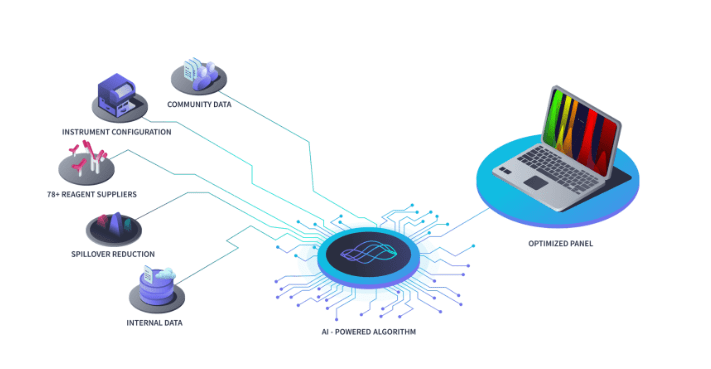
FluoroFinder simplifies high-parameter panel design by integrating the data, tools, and resources researchers need within an all-in-one platform. This connected, data-driven approach reduces manual effort, supports more informed design decisions, and helps researchers optimize panel performance with greater confidence before experiments begin.
Beyond Spectral Overlap: Key Considerations in High-Parameter Panel Design
Although spectral overlap is one of the most widely recognized challenges in flow cytometry panel design, successful high-parameter panels depend on balancing many interconnected biological and technical variables. Antigen density, marker co-expression, fluorochrome brightness, spreading error, and autofluorescence all influence panel performance and should be evaluated together rather than in isolation. Collectively, these factors influence data quality and the ability to accurately distinguish biologically meaningful cell populations.
Technical considerations further shape panel performance. Instrument laser configurations, optical filters, detector sensitivity, and the availability of validated antibody-fluorochrome conjugates all affect which reagents are appropriate for a given experiment. Reagent availability can also limit fluorochrome choices, requiring researchers to balance ideal panel design with practical laboratory constraints.
Rather than relying on separate databases, manufacturer websites, spreadsheets, and standalone tools, researchers can access antibody discovery, panel design, fluorophore comparison, spectral visualization, and instrument-specific guidance within their FluoroFinder Dashboard. Connecting these resources within a single workflow reduces manual effort and supports more informed decisions throughout the panel design process.
Choosing the Right Antibodies and Experimental Inputs
Effective panel design begins with selecting the right antibodies for the biological question and experimental system. FluoroFinder’s Antibody Search enables researchers to search and compare more than 3.2 million antibodies and over 1,600 unique conjugates from more than 100 suppliers within a single platform. Researchers can compare antibody clones, fluorochrome conjugates, validation data, and supplier options without switching between multiple manufacturer catalogs. By bringing comprehensive reagent information together in one place, Antibody Search simplifies reagent discovery, reduces manual comparison, and accelerates panel development.
The Cell Types Tool adds biological context to the design process by helping researchers explore cell populations and marker co-expression patterns before assigning fluorochromes. Understanding which markers are likely to be expressed together can inform fluorochrome selection and help reduce potential conflicts as panel complexity increases.
Researchers can also explore published OMIPs (Optimized Multicolor Immunofluorescence Panels) as a reference when planning new experiments or evaluating existing panel designs. Access to established panels can provide additional context for marker selection and fluorochrome assignments before moving into panel optimization.
With antibodies selected and key biological considerations established, the next step is optimizing how those reagents will perform within the experimental system and instrument configuration. Powered by IntelliPanel™ 2.0, FluoroFinder’s Flow Cytometry Panel Builder integrates panel complexity analysis, co-expression visualization, and intelligent fluorochrome assignment into a workflow that aligns biological requirements with instrument capabilities. Its Co-Expression Group module evaluates biologically linked markers collectively, helping maintain population resolution while supporting more effective fluorochrome assignment.
Optimizing Panel Performance with Integrated Data
Evaluating fluorochrome assignments within the context of a specific instrument helps validate panel design before data acquisition. Comparing excitation and emission spectra while assessing spectral overlap, spillover, and fluorochrome compatibility can improve panel performance and reduce the need for iterative redesign.
FluoroFinder integrates the Fluorescent Dye Directory, Cytometer Database and enhanced Spectra Viewer directly into the panel design ecosystem, giving researchers access to the spectral data needed to evaluate fluorophore performance and compatibility in one place. Researchers can compare fluorophore properties, visualize spectral profiles, and assess compatibility across multiple laser configurations, making it easier to identify potential conflicts and refine panel designs before moving to the lab.
Complex Doesn’t Have to Be Complicated
As high-parameter flow cytometry continues to evolve, successful panel design increasingly depends on integrating biological context, reagent selection, spectral analysis, and instrument-specific guidance throughout the planning process. Rather than relying on disconnected resources and manual comparisons, researchers benefit from a unified workflow that streamlines decision-making and helps reduce costly redesign later in the experiment.
By connecting panel design, antibody discovery, fluorophore comparison, spectral visualization, instrument selection, and educational resources, FluoroFinder helps researchers move seamlessly from experimental planning to execution with fewer manual steps and a more efficient path to high-quality experimental results.
Explore the FluoroFinder ecosystem:
- Flow Cytometry Panel Builder for building and optimizing multicolor and spectral panels, including co-expression group evaluation and complexity scoring.
- Antibody Search for comparing commercially available antibodies, clones, and conjugates.
- Fluorescent Dye Directory for evaluating fluorophore properties, brightness, and spectral characteristics.
- Spectra Viewer for visualizing fluorochrome compatibility and spectral overlap.
- Cytometers for comparing instrument configurations and laser layouts.
- Cell Types Tool for exploring marker co-expression patterns before assigning fluorochromes.
- OMIPs for exploring published Optimized Multicolor Immunofluorescence Panels as references for experimental planning and panel design.
- Articles, Webinars, Flow Cytometry Training, and Partner Resources for continuous learning, best practices, and new panel design strategies.
Whether designing a new high-parameter panel or refining an existing workflow, FluoroFinder provides researchers with an integrated ecosystem of panel design tools, educational resources, webinars, training, and technical guidance. Create a free FluoroFinder account to explore the platform and streamline every stage of your next flow cytometry experiment.